


Program Presentation
Currently, the large-scale use of fossil and nuclear fuels is one of the main features of what is known as an industrialized society.
The environmental impact caused by the manipulation and transformation of the various conventional energy sources has generated a new and different framework that began during the oil energy crisis of 1973; global warming, the hole in the ozone layer, acid rain, desertification, the storage of radioactive waste, etc, have all led to increased awareness by the industrialized societies.
In this regard, governments issue and enact increasingly more restrictive laws regarding environmental criteria for the energy sector, which suggests an important role of renewable energy as the expected solution that should lead in the twenty-first century toward what is known as "sustainable development".
Looking at it from a practical approach, the Application of Renewable Energy Program is essential in order to know the main sustainable technologies that exist today and their application to successfully confront the energy crisis problems of the new century.
Who is the programme for?
The Application of Renewable Energy Program is especially designed to satisfy two different types of groups:
- People without a university degree who may want a quality education in this field for personal gain or experience.
- University graduates who, in addition to their basic training, want practical expertise in the energy management field to broaden their career opportunities.
Diploma
Successful completion of the Program will enable you to be awarded the degree in Specialization in APPLICATION OF RENEWABLE ENERGY.
After successfully completing the Program, the student will receive the degree as awarded by the University where they have enrolled.
Program Structure
The credit structure for the Application of Renewable Energy is found in the following table. Since it is a distance Program and not subject to classes, a specific start date is not set, so the student can enroll at any time, provided there are spaces available:
| CREDITSa | |
|---|---|
| Subjects | 30 |
| TOTAL | 30 |
a. The equivalent value of credits can differ according to the issuing university.
Duration
The program in Application of Renewable Energy has 30 credits.
The duration of the program in Application of Renewable Energy varies between 6 and 9 months, depending on the student's dedication. In this period of time, the student must have successfully passed all the evaluated activities and approved the Final Project, if any.
Objectives
General objectives:
- To provide guidance to those who wish to acquire the basic skills needed for optimal energy management, both at the user-level as well as on a larger scale, by proposing methodologies and case studies of environmentally and energetically sustainable facilities.
Specific objectives:
- To analyze the problems, risks and uncertainties of the environmental impacts associated with energy use.
- To become familiar with the current energy framework and future prospects.
- To establish energy criteria best suited to address the different problems that arise in the professional world.
- To become aware of the evolution of consumption and the need to make efficient use of energy.
- To understand the importance of the use of renewable energy with the goal of achieving sustainable development.
- To lay the groundwork for the implementation and maintenance of solar, wind and water facilities.
Career Opportunities
Some of the career opportunities in the Renewable Energy Program are:
- Work in municipalities as technical/consultant in renewable energy.
- Maintenance technician of wind farms.
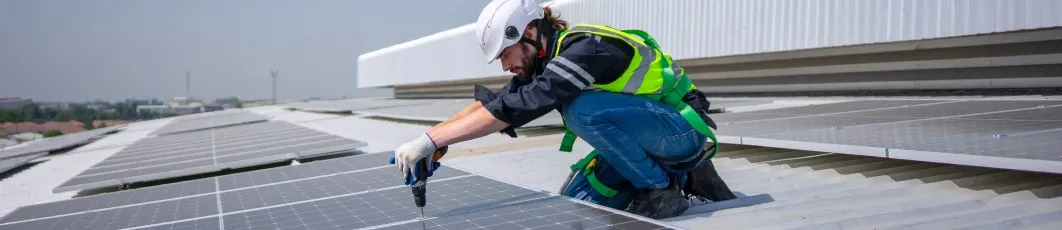
- Solar systems installer.
- Teaching.
Study Plan
The Application of Renewable Energy Program consists of eight courses, including practical case studies on different types of energy management.
The objectives are to introduce, first, the theoretical, conceptual and historical foundations involved in water management and, second, organizational, social and technological implementation.
The goal is for students to gain an overview of water management through multidisciplinary related topics.
The courses and credits for the Renewable Energy program are shown in the following table:
| Application of Renewable Energy | ||
|---|---|---|
| # | TOTAL SUBJECTS | CREDITS |
| TOTAL | 30 | |
| 1 | Introduction | 5 |
| 2 | Solar thermal energy | 4 |
| 3 | Solar photovoltaic energy | 4 |
| 4 | Hydroelectric energy | 5 |
| 5 | Wind energy | 5 |
| 6 | Geothermal energy | 3 |
| 7 | Biomass energy | 4 |
| 8 | Marine energy | -- |
| 9 | Case studies | -- |
These subjects, are independent, yet are structured according to a coherent teaching sequence that facilitates the understanding of increasing complexity. Each subject is divided into basic thematic units or chapters, the contents of which include printed material to be studied in order to satisfactorily answer the assessment tests.
Management
- Dr. Eduardo García Villena. Director of the Environmental Area in the International Ibero-american University (UNINI)
FUNIBER Training Scholarships
The Ibero-american University Foundation (FUNIBER) periodically delivers an economic baseline with extraordinary character for scholarships in FUNIBER Training.
To apply for it, you only need to send your application for a scholarship on the website’s main page with the required data, and the evaluation committee will examine the suitability of your candidature to be granted economic aid, in the form of a scholarship in FUNIBER Training.